How chlamydia hijacks a cell and hides from the immune system
Last reviewed November 16, 2026. OwieClear editorial team. Waiting for clinician review. Not medical advice. Talk with your doctor about your own care.
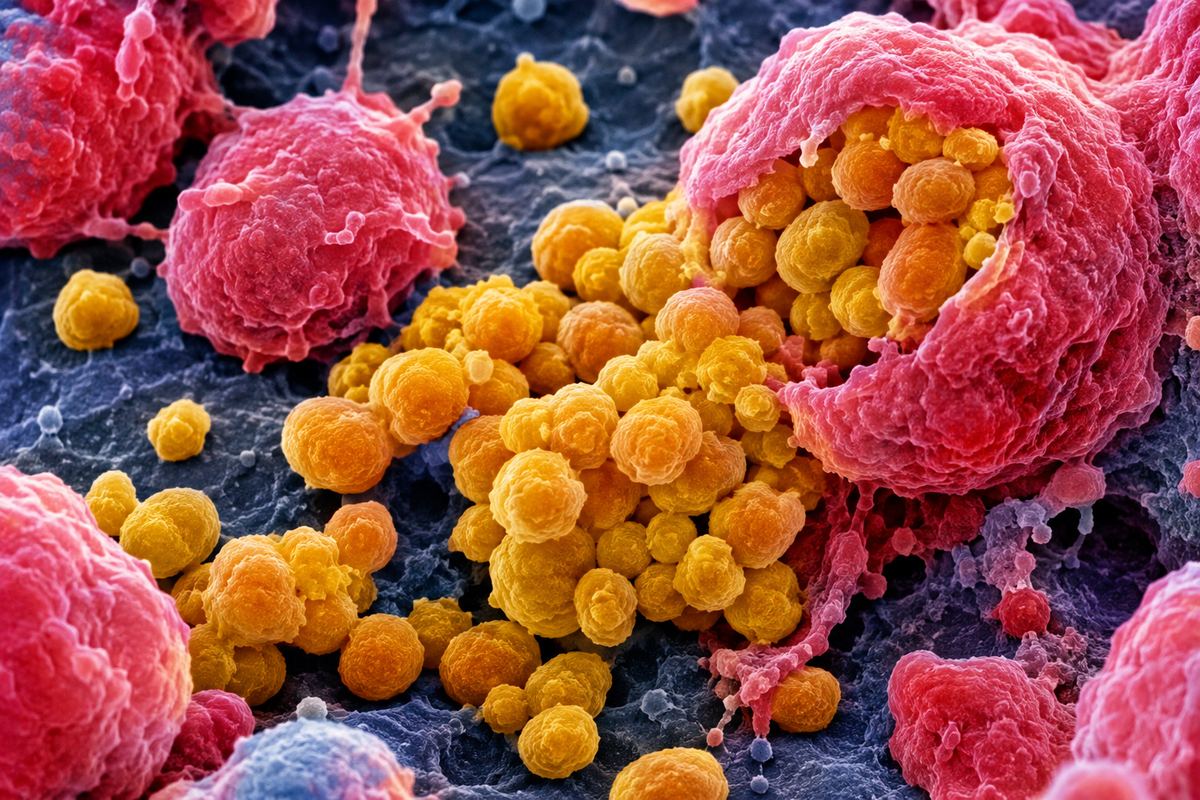
Chlamydia alternates between two completely different physical forms, one built for travel and one built for multiplication. Nothing else that infects humans does quite this.
The switch between them, and what it does to the cell in between, is the whole mechanism of the infection.
Related pages: Chlamydia
The bottom line
- The infectious form, the elementary body, is tough, small and metabolically inactive.
- Inside the cell it converts into the reticulate body, which is fragile and divides rapidly.
- It lives in a membrane compartment called an inclusion and takes nutrients and energy from the host cell.
- After roughly 48 to 72 hours, new elementary bodies are released to infect other cells.
- How the signal to switch between the two forms is controlled.
- How much of the damage comes from the infection itself versus the immune response to it.
The story, step by step
- 1. The elementary body ()
- 2. The reticulate body ()
- 3. Energy piracy ()
- 4. Evading destruction ()
- 5. The exit ()
What the evidence labels mean
Armour for the journey
What happens
The form that travels between people and between cells is built like a seed.
What the research shows
- It is small, dense and metabolically dormant, doing essentially nothing while outside a cell.
- Its outer membrane proteins are cross-linked by disulfide bonds, making a rigid shell that tolerates the hostile conditions of mucosal surfaces.
- It cannot divide and cannot grow. Its only job is to reach a new cell and get inside.
- Once attached, it triggers the cell to engulf it, so the cell does much of the work of its own infection.
Why it matters
A form that does nothing metabolically is also a form with very little for the immune system to notice.
What's still uncertain
- Exactly which surface proteins drive attachment to host cells is still being worked out.
Read more
- MedlinePlus: Chlamydia infectionsGovernment
Next: The reticulate body
Armour off, multiplication on
What happens
Once inside, the organism changes completely.
What the research shows
- The disulfide cross-links are reduced, the shell loosens, and the particle expands into a larger, fragile form.
- This reticulate body is metabolically active and divides by binary fission like an ordinary bacterium.
- It stays within a membrane-bound compartment called an inclusion, which it modifies into a protected niche.
- Hundreds of bacteria can accumulate inside a single inclusion in one cell.
Why it matters
The replicating form is defenceless outside a cell and the travelling form cannot replicate. Neither works alone, which is why the cycle exists.
What's still uncertain
- What triggers conversion in either direction is not fully understood.
Read more
- MedlinePlus: Chlamydia infectionsGovernment
- OwieClear: What chlamydia isOwieClear
Next: Energy piracy
Taking what it cannot make
What happens
Chlamydia has a drastically reduced genome and has lost the ability to make much of what it needs.
What the research shows
- It carries nucleotide transport proteins that import ATP, the cell's energy currency, directly from the host.
- Researchers have called it an energy parasite for this reason, and the term is literal rather than figurative.
- The inclusion also intercepts vesicles from the host's Golgi apparatus, taking lipids, cholesterol and amino acids.
- The bacterium is effectively plumbed into the cell's supply lines, which is why it needs a living cell rather than a dead one.
Why it matters
The dependence is total. This is why chlamydia cannot be cultured on an ordinary plate and why it was so hard to study.
What's still uncertain
- How much of the infected cell's energy budget is diverted has been measured in culture rather than in people.
Read more
- MedlinePlus: Chlamydia infectionsGovernment
Next: Evading destruction
Two switches, both turned off
What happens
A cell that swallows a bacterium normally destroys it. Chlamydia prevents both of the cell's responses.
What the research shows
- Normally the compartment holding a swallowed bacterium fuses with lysosomes, which digest the contents with acid and enzymes.
- Chlamydia uses a type III secretion system, a needle-like apparatus that injects proteins into the host cell, to reroute the inclusion away from lysosomes.
- It also blocks apoptosis, the cell's self-destruct program, which a cell would otherwise use to kill itself and the invader with it.
- Because the bacterium sits inside a host cell and inside its own compartment, antibodies cannot reach it and most immune cells cannot either.
Why it matters
Hidden inside a cell is why antibiotics must be lipid-soluble enough to get in, and why penicillin-type drugs do not work.
What's still uncertain
- The full set of injected effector proteins, and what each one does, is still being catalogued.
Read more
- CDC: STI treatment guidelines, chlamydial infectionsGovernment
- OwieClear: How chlamydia drives silent scarringOwieClear
Next: The exit
Burst, or slip out quietly
What happens
After roughly two to three days, the cycle completes.
What the research shows
- Reticulate bodies condense back into elementary bodies, re-forming the rigid outer shell.
- Some inclusions rupture the host cell, releasing everything at once.
- Others extrude, pushing out a packaged portion while leaving the host cell alive.
- Either way, hundreds to thousands of new infectious particles are released to infect neighbouring cells.
- The cycle then repeats, and the infection spreads along the mucosal surface and sometimes upward into the uterus and fallopian tubes.
Why it matters
Extrusion without killing the cell is one reason infection can continue quietly for months with no inflammation anyone would notice.
What's still uncertain
- Which exit route predominates in human infection, as opposed to cell culture, is not known.