What really happens in Alzheimer's, study by study
Last reviewed November 15, 2026. OwieClear editorial team. Waiting for clinician review. Not medical advice. Talk with your doctor about your own care.
Alzheimer's disease is the most common cause of dementia. For a long time it was described simply as two proteins building up in the brain. That is still the core of it, but research over the last 20 years has filled in what sets that buildup off and what keeps it going.
Below we walk through the main findings in order: what is physically in the brain, when it starts, and the four forces researchers are now studying as drivers (germs, the brain's own immune cells, fuel supply, and sleep). We finish with what today's treatments can and can't do.
Related pages: Memory loss and dementia (Alzheimer's)
The bottom line
- Two proteins, amyloid and tau, build up and damage the connections between brain cells.
- The changes start 15 to 25 years before the first memory symptoms.
- Removing amyloid with new antibody treatments modestly slows early Alzheimer's. It doesn't stop or reverse it.
- Up to about 45% of dementia worldwide is linked to risk factors that can be changed, like hearing loss, blood pressure and smoking.
- Whether infections help start it. The evidence is getting stronger but isn't settled.
- Why some people have plaques and tangles yet stay sharp.
- Whether treating insulin resistance, sleep problems or gum disease would change the course of the disease. None of these is proven.
The studies, in order
- 1. Plaques and tangles (Established by decades of autopsy and lab work)
- 2. It starts decades early (Bateman and others (DIAN study), 2012)
- 3. Amyloid as a trap (Soscia, Kumar, Moir, Tanzi and others, 2010 to 2018)
- 4. Germs in the brain (Dominy and others, 2019; Eyting, Geldsetzer and others, 2025)
- 5. The brain's cleanup crew (Jonsson and others, and Guerreiro and others, 2013)
- 6. Fuel trouble (de la Monte, Wands and others, from 2005)
- 7. The nightly rinse (Xie, Nedergaard and others, 2013)
- 8. What treatment does now (van Dyck and others, 2023 (CLARITY AD); Livingston and others, 2024 (Lancet Commission))
What the evidence labels mean
Two proteins choke the connections between brain cells
What they did
Brain cells (neurons) talk to each other across tiny gaps called synapses. Researchers have studied what is physically different in an Alzheimer's brain.
What they found
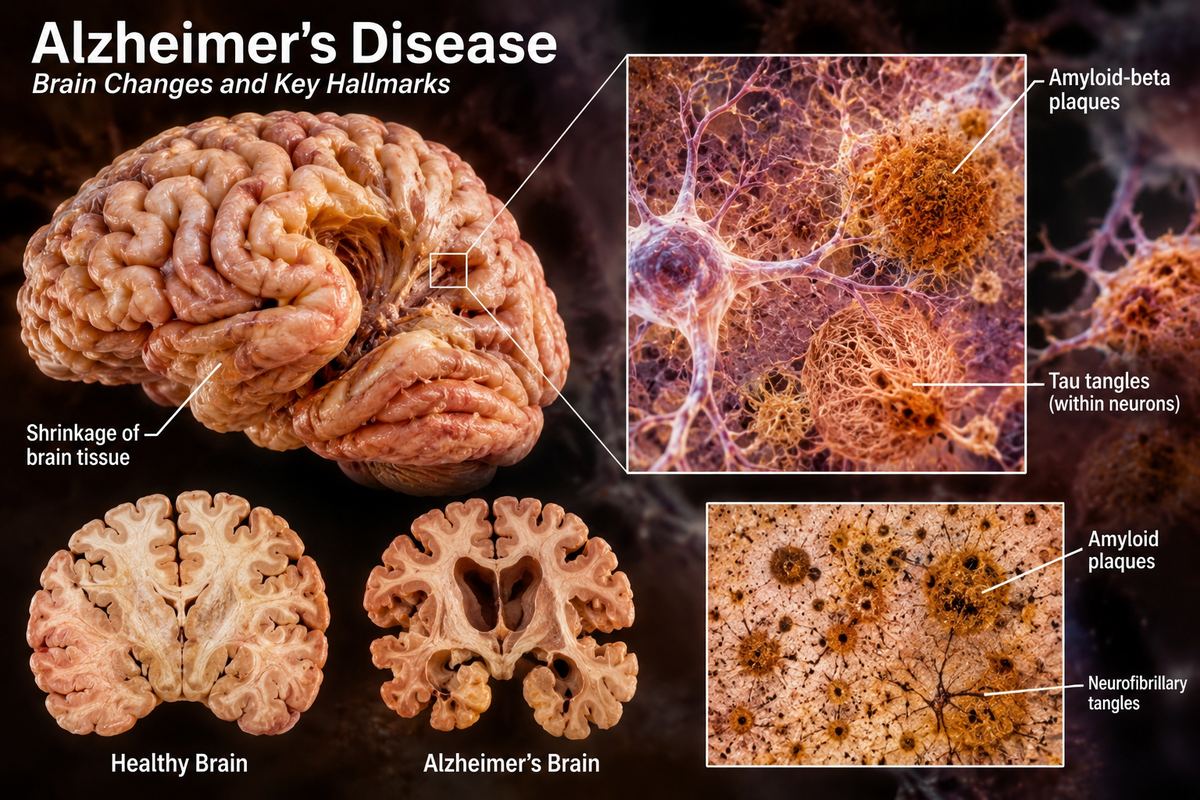
- Amyloid plaques: sticky clumps of a protein fragment called beta-amyloid build up in the spaces between neurons.
- Tau tangles: inside neurons, a protein called tau normally keeps the cell's internal transport tracks straight. In Alzheimer's it twists into tangles, and the tracks collapse.
- The damage follows a pattern, usually starting in memory areas and spreading. Brain tissue shrinks as cells die.
What it means
The two hallmarks are what a pathologist looks for to confirm Alzheimer's. Tau damage tracks more closely with symptoms than amyloid does.
What it can't tell us
- Some people die with plenty of plaques and tangles and had no dementia, so the proteins alone don't explain everything.
- Most people with dementia have more than one thing going on, often Alzheimer's changes plus blood vessel damage.
Read it yourself
Next: It starts decades early
The brain changes begin 15 to 25 years before symptoms
What they did
Researchers followed 128 people from families carrying a rare gene change that causes Alzheimer's at a predictable age. Because they knew roughly when symptoms would start, they could line up brain scans, spinal fluid and memory tests against that date.
What they found
- Spinal fluid amyloid levels started shifting about 25 years before symptoms were expected.
- Amyloid showed up on brain scans, tau rose, and the memory areas began shrinking about 15 years before.
- Lower brain energy use and small memory changes appeared about 10 years before, and wider thinking problems about 5 years before.
What it means
Alzheimer's is not a disease of the moment symptoms appear. It is decades in the making, which is why prevention and early treatment get so much attention.
What it can't tell us
- These were families with an inherited early-onset form, which is less than 1% of cases. The timing may differ in the common late-onset form, though other studies point the same way.
Read it yourself
- Bateman 2012, NEJMJournal
Next: Amyloid as a trap
Beta-amyloid behaves like a germ-catching net
What they did
Researchers noticed that beta-amyloid looks like the body's antimicrobial peptides, the short proteins the immune system uses to kill germs. They tested it against bacteria, yeast and viruses, in dishes, worms and mice.
What they found
- Beta-amyloid killed or trapped 8 common germs, in some cases better than LL-37, a known human germ-killing protein.
- Mice and worms making beta-amyloid survived infections better than those that didn't.
- Infection caused amyloid to clump rapidly around the germs, trapping them.
What it means
This turned the usual story around. Amyloid may not be pure waste. It may be part of the brain's defenses, and plaques may be the leftovers of a defense that keeps getting triggered.
What it can't tell us
- Most of this is in dishes, worms and mice. Protection against herpes virus in mice was weak, and one later study found none at all.
- Even if amyloid fights germs, that doesn't prove germs cause Alzheimer's.
Read it yourself
- Soscia 2010, PLoS ONEJournal
- Kumar 2016, Science Translational Medicine (PubMed)PubMed
- Eimer 2018, Neuron (PubMed)PubMed
Next: Germs in the brain
Gum bacteria, herpes viruses, and a vaccine that lowered dementia
What they did
One team looked for the gum-disease bacterium Porphyromonas gingivalis in brains of people who had died with Alzheimer's, and tested it in mice. A separate team used an accident of policy in Wales, where the shingles vaccine was offered to people who turned 79 after a cutoff date but never to those who had just turned 80, creating two near-identical groups.
What they found
- The gum bacterium's toxic enzymes, called gingipains, were found in Alzheimer's brains, and higher levels went with more tau damage.
- Infecting mice by mouth led to the bacteria reaching the brain and more beta-amyloid being made. Blocking the enzymes reduced the damage.
- In Wales, 282,541 older adults were compared. Getting the shingles vaccine cut the chance of a new dementia diagnosis over 7 years by about 20%.
- The vaccine didn't change other causes of illness or death, which argues against it being a general healthy-person effect.
What it means
Together these support the idea that infections the brain can't fully clear help drive the damage. The Wales study is the strongest evidence so far because its design comes close to a randomized trial.
What it can't tell us
- The gum-disease work was funded by a company developing a drug for it, and that drug later failed to help patients in a trial.
- The vaccine study shows an effect, not how it works. It could be less virus reactivation, or a general immune boost. A randomized trial is still needed.
Read it yourself
- Dominy 2019, Science AdvancesJournal
- Eyting 2025, Nature (PubMed)PubMed
- Stanford Medicine: plain summary of the Wales studyUniversity
Next: The brain's cleanup crew
When the brain's own immune cells can't keep up
What they did
Microglia are the brain's resident immune cells. They clear debris, including amyloid. Two teams sequenced the DNA of thousands of people with and without Alzheimer's, looking for rare gene changes.
What they found
- A rare change in a gene called TREM2, which microglia use to sense and swallow debris, raised the risk of Alzheimer's about 3 to 5 times.
- That is about the same size of risk as carrying one copy of APOE4, the common risk gene.
- Older people carrying the TREM2 change but without Alzheimer's still scored worse on thinking tests.
What it means
This was strong evidence that the immune system isn't just reacting to Alzheimer's but helping cause it. If the cleanup crew works poorly, damage builds up.
What it can't tell us
- The variant is rare, under 1% of people, so it doesn't explain most cases and isn't worth testing for.
- Microglia seem to be protective early and harmful when stuck 'on' later, which makes them tricky to target with drugs.
Read it yourself
- Jonsson 2013, NEJMJournal
- Guerreiro 2013, NEJMJournal
Next: Fuel trouble
Brain cells stop using sugar properly, the 'type 3 diabetes' idea
What they did
Researchers measured insulin signaling in Alzheimer's brain tissue and produced similar damage in animals by blocking insulin in the brain.
What they found
- In Alzheimer's, the brain responds poorly to insulin, so neurons take in and burn less sugar. Brain scans show the same low energy use years before symptoms.
- Neurons short of energy are worse at clearing waste proteins and maintaining their internal tracks.
- The researchers proposed calling it 'type 3 diabetes', a brain-limited form of insulin resistance.
What it means
It explains why diabetes, obesity and high blood sugar raise dementia risk, and why exercise helps. It is one reason diabetes medicines have been tested in Alzheimer's.
What it can't tell us
- 'Type 3 diabetes' is a nickname used by some researchers, not an official diagnosis. Don't expect a doctor to use it.
- Low brain energy use may be partly a result of dying cells rather than a cause.
- Trials of insulin and diabetes drugs for Alzheimer's have so far been disappointing.
Read it yourself
Next: The nightly rinse
The brain washes out waste during sleep
What they did
Researchers watched dye move through the brains of living mice while they were awake, asleep and under anesthesia, and measured how fast injected beta-amyloid was cleared.
What they found
- During sleep, the space between brain cells grew by about 60%, letting fluid flow through and flush waste out.
- Beta-amyloid was cleared about twice as fast in sleeping mice as in awake ones.
- It was the sleep state itself, not the time of day, that made the difference.
What it means
This gave a physical reason why poor sleep is linked to dementia, and why sleep is treated as something worth protecting rather than a luxury.
What it can't tell us
- It was done in mice using methods that can't be repeated in people. Human studies so far are indirect.
- No trial has shown that improving sleep prevents Alzheimer's.
Read it yourself
- Xie 2013, ScienceJournal
- NIH: Brain may flush out toxins during sleepGovernment
Next: What treatment does now
Clearing amyloid helps a little. Prevention may help more
What they did
CLARITY AD randomly gave 1,795 people with early Alzheimer's either lecanemab, an antibody that clears amyloid, or a placebo, for 18 months. Separately, 27 dementia experts pooled the evidence on risk factors that can be changed.
What they found
- Lecanemab slowed decline by 27% over 18 months. In plain terms, that is a small difference on a rating scale, not an improvement.
- Brain swelling or small bleeds (called ARIA) showed up on scans in 12.6% and 17.3% of people on the drug. Most had no symptoms, but MRI monitoring is required, and the risk is higher in people with APOE4.
- The Lancet Commission found that addressing 14 risk factors could prevent or delay about 45% of dementia worldwide.
What it means
For the first time there are treatments that change the disease rather than just the symptoms, but the benefit is modest and only for people in the early stage who qualify. Prevention still has the bigger numbers behind it.
What it can't tell us
- Whether a 27% slowing is noticeable to families is debated among doctors.
- The 45% prevention figure assumes the risk factors cause dementia and could be removed entirely, which is a best case, not a promise.