What HPV is and how it gets into the body
Last reviewed November 16, 2026. OwieClear editorial team. Waiting for clinician review. Not medical advice. Talk with your doctor about your own care.
HPV doesn't travel in your bloodstream and doesn't make you feel sick. It lives entirely in the surface layers of skin and the linings of the body, and that single fact explains almost everything else about it: why you never notice it, why your immune system is slow to find it, and why it can sit there for years.
Here is what the virus is and how it gets in.
Related pages: HPV infection · Genital warts (HPV)
The bottom line
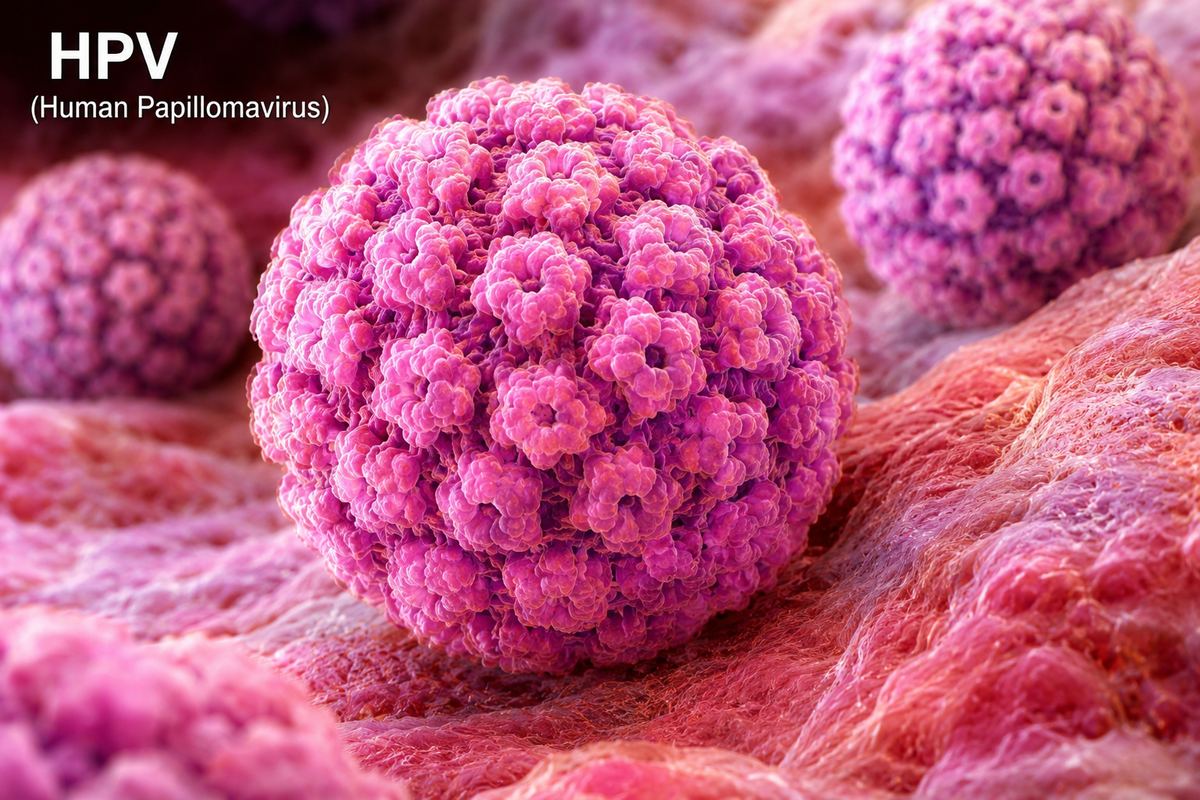
- HPV is a small, non-enveloped, double-stranded DNA virus. More than 200 types are known.
- It infects only stratified squamous epithelium: skin, and the linings of the cervix, vagina, vulva, penis, anus, mouth and throat.
- It gets in through tiny breaks in the surface and reaches the dividing cells at the bottom layer.
- It does not spread through the blood and does not infect internal organs.
- How much HPV spreads by non-sexual skin contact, and how often it passes from mother to baby.
The story, step by step
- 1. What it is (Established virology)
- 2. Where it lives ()
- 3. Getting in ()
- 4. Staying quiet ()
- 5. How it passes (CDC and epidemiological studies)
What the evidence labels mean
A small DNA virus with no outer envelope
What happens
HPV carries a circular, double-stranded DNA genome of about 8,000 letters inside a protein shell made mostly of a protein called L1.
What the research shows
- It has no fatty envelope, which makes it unusually tough: it survives drying and ordinary surfaces better than enveloped viruses like flu.
- There are over 200 known types, numbered in order of discovery. About 40 infect the genital and anal area.
- Its small genome encodes only a handful of proteins, which is why it has to borrow so much from the host cell.
- The vaccine is made from empty shells of that L1 protein, with no viral DNA inside, so it cannot cause infection.
Why it matters
Understanding that it is a skin and lining virus, not a blood virus, is the key to the whole subject.
What's still uncertain
- Type numbering reflects the order they were found, not how dangerous they are.
Read more
- CDC: About genital HPV infectionGovernment
- National Cancer Institute: HPV and cancerGovernment
Next: Where it lives
Only one kind of tissue will do
What happens
HPV can only infect stratified squamous epithelium: tissue built in layers, where new cells are made at the bottom and pushed upward.
What the research shows
- That includes skin, and the lining of the cervix, vagina, vulva, penis, anus, and the back of the mouth and throat.
- Different HPV types prefer different sites. The types that cause common hand warts are not the ones that cause genital infections.
- The transformation zone of the cervix, where one cell type meets another, is particularly vulnerable, which is why cervical cancer is the most common HPV cancer.
Why it matters
The virus's tissue preference is why screening targets the cervix, and why HPV cancers appear in a specific list of places rather than anywhere.
What's still uncertain
- Why the transformation zone is so susceptible isn't fully explained.
Read more
Next: Getting in
Through microscopic breaks, down to the dividing cells
What happens
HPV cannot get through intact surface skin. It needs a break.
What the research shows
- Microscopic tears or friction points, too small to see or feel, let the virus reach the basal layer, the bottom layer of actively dividing cells.
- That layer is where the tissue's stem-like cells live, the ones that keep replacing the cells above them.
- Once inside a basal cell, the viral DNA sits in the nucleus as a separate circular ring, called an episome, rather than joining the cell's own chromosomes.
- Because basal cells keep dividing for years, the virus gets a long-lasting base.
Why it matters
This is why condoms reduce but don't eliminate transmission: they don't cover all the skin that can be involved, and no visible injury is needed.
What's still uncertain
- Exactly how much damage is required, and which receptors the virus uses, is still being worked out.
Read more
- CDC: About genital HPV infectionGovernment
- OwieClear: How HPV hijacks your cellsOwieClear
Next: Staying quiet
It never bursts the cell, so nothing raises the alarm
What happens
Most viruses multiply and then destroy the host cell to escape, which releases debris that immune cells recognize immediately.
What the research shows
- HPV does not kill its host cell. It waits for the infected cell to mature and travel upward on its own.
- New virus particles are assembled near the surface and leave inside dead skin cells as they flake off.
- There is no inflammation, no cell death signal, and no virus in the bloodstream for the immune system to find.
- That is why there is typically no symptom at the time of infection, and why the immune response takes months to get going.
Why it matters
The absence of symptoms isn't a mild version of infection. It's the virus's actual strategy, and it is the reason HPV is so widespread.
What's still uncertain
- How HPV suppresses the local immune response in detail is still being studied.
Read more
- OwieClear: The phases of an HPV infectionOwieClear
- National Cancer Institute: HPV and cancerGovernment
Next: How it passes
Skin to skin, usually sexual, usually unknowable
What happens
Researchers have tracked how genital HPV types move between people.
What the research shows
- Transmission is by skin-to-skin contact during vaginal, anal and oral sex. Penetration is not required.
- Most sexually active people acquire HPV at some point.
- Because infection causes no symptoms and clearance takes a year or two, it is usually impossible to say when someone caught it or from whom.
- Rarely, HPV can pass from mother to baby at birth and cause warty growths in the airway.
Why it matters
A positive HPV test is not evidence of recent infection or of anything a partner did. This is probably the most important practical point on this page.
What's still uncertain
- The role of non-sexual transmission, such as shared objects, is debated for genital types.
- How often the virus passes in any single encounter isn't well measured.
Read more
- CDC: About genital HPV infectionGovernment
- OwieClear: The phases of an HPV infectionOwieClear