What high blood pressure actually is
Last reviewed November 17, 2026. OwieClear editorial team. Waiting for clinician review. Not medical advice. Talk with your doctor about your own care.
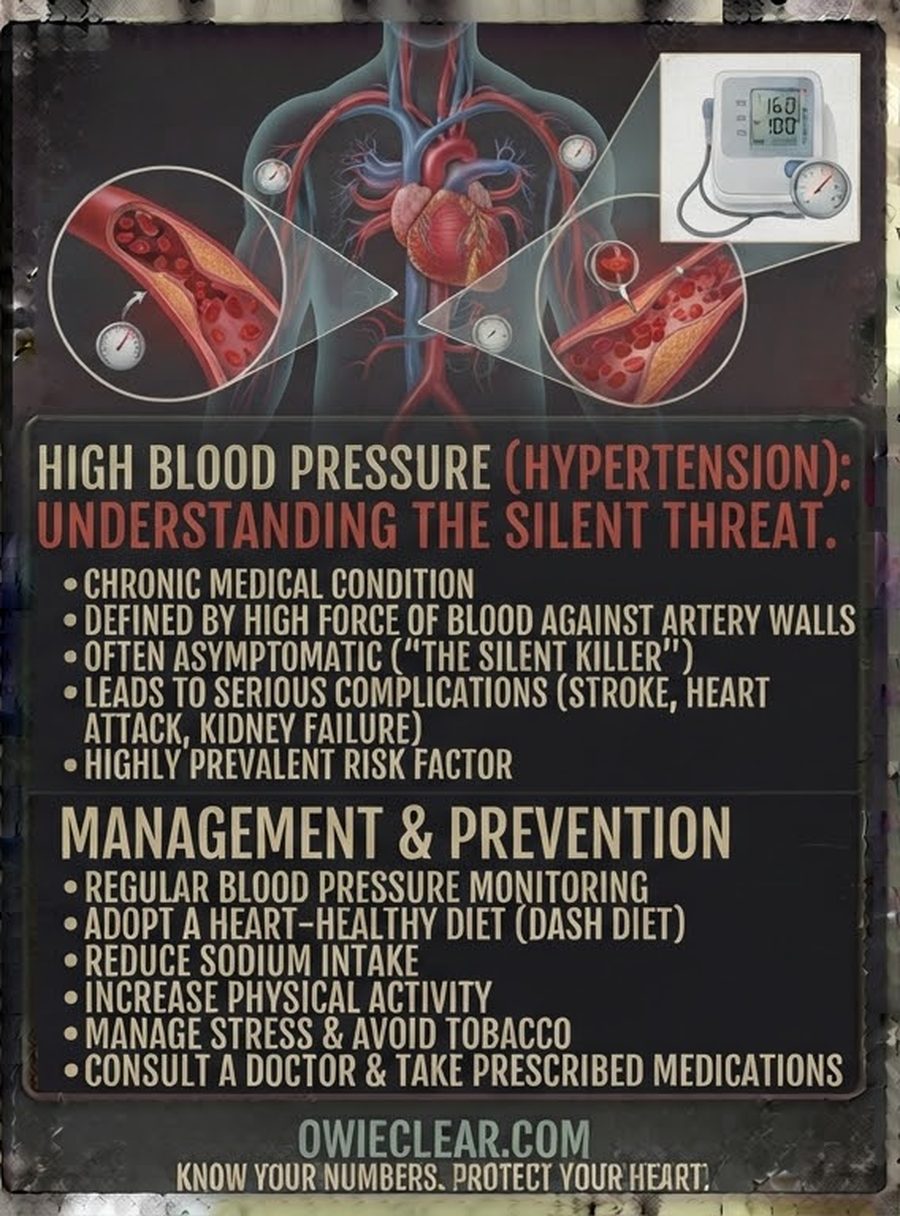
High blood pressure is the force of blood against the artery walls being persistently higher than the vessels and the organs they feed can tolerate.
It is called the silent killer for a specific reason: it causes no sensation at all until it has already caused damage. That single fact drives nearly everything else about how it is found and treated.
Related pages: High blood pressure (hypertension)
The bottom line
- Hypertension is defined as 130/80 mmHg or higher in current United States guidelines.
- Most people with hypertension have no symptoms whatsoever.
- Nearly half of United States adults have high blood pressure.
- Lowering blood pressure reduces stroke, heart attack, heart failure and kidney disease.
- Why blood pressure rises with age in industrialized societies and much less in some others.
- The optimal target for every group, which differs between guidelines.
The story, step by step
What the evidence labels mean
What systolic and diastolic mean
What happens
Two measurements of one circuit.
What the research shows
- The top number, systolic, is the pressure in the arteries when the heart contracts and pushes blood out.
- The bottom number, diastolic, is the pressure that remains between beats, when the heart is filling.
- Both matter. In people under about 50, diastolic pressure predicts risk strongly. From middle age onward, systolic pressure becomes the better predictor, because arteries stiffen and systolic rises while diastolic often falls.
- The gap between them, the pulse pressure, widens with arterial stiffening and is itself a marker of vascular age.
- Pressure is measured in millimetres of mercury, mmHg, a holdover from the mercury columns of the original instruments.
- A single high reading is not hypertension. The diagnosis requires readings on separate occasions, or out-of-office measurement, because blood pressure varies constantly with posture, activity, emotion and time of day.
Why it matters
The number that matters most changes with age, which is why a diastolic of 78 is reassuring at 30 and tells you little at 70.
What's still uncertain
- Why pulse pressure predicts risk independently, which is partly but not fully explained by arterial stiffness.
Read more
- NHLBI: High blood pressureGovernment
- CDC: High blood pressureGovernment
- MedlinePlus: High blood pressureGovernment
Next: Silent
Why there are no symptoms, and the myths
What happens
The central practical problem.
What the research shows
- Arteries have no pain fibres that respond to pressure. Nothing about a raised pressure generates a sensation, which is why people feel entirely well at 180/110.
- Headaches are not a reliable sign. Studies comparing symptom diaries with ambulatory monitoring have repeatedly failed to find a relationship at ordinary levels of elevation. Headache does occur in severe hypertension and in hypertensive emergency.
- Nosebleeds are commonly attributed to high blood pressure, and the causal link in routine practice is weak. A nosebleed is usually a nose problem.
- Dizziness is non-specific and, in someone already on treatment, is more often a medicine effect than a sign of high pressure.
- Flushing, warmth, fatigue and a feeling of pressure in the head are all reported and none of them tracks reliably with actual readings.
- The practical consequence: feeling fine tells you nothing. The only way to know is to measure.
- The symptoms that do matter are those of a hypertensive emergency, when a very high pressure is accompanied by chest pain, breathlessness, severe headache, vision change, weakness or confusion. That is an emergency rather than a symptom of ordinary hypertension.
Why it matters
Every myth here points the same way: toward people deciding they are fine without measuring, and toward stopping medicine when they feel well.
What's still uncertain
- Whether very severe hypertension causes headache directly or through other mechanisms.
Read more
- CDC: High blood pressureGovernment
- NHLBI: High blood pressureGovernment
- MedlinePlus: High blood pressureGovernment
Next: The damage
What the pressure actually does
What happens
Why it matters if nothing hurts.
What the research shows
- Arteries respond to sustained high pressure by thickening and stiffening. The lining, the endothelium, is damaged by the mechanical stress, which accelerates the build-up of plaque.
- The heart pumps against higher resistance and thickens in response, called left ventricular hypertrophy. A thickened heart relaxes poorly, which leads to heart failure even when pumping strength looks normal.
- The kidneys filter through tiny vessels that are especially vulnerable, which is why hypertension is a leading cause of kidney failure.
- The brain's small vessels suffer in the same way, producing both strokes and the slow accumulation of white matter damage associated with vascular dementia.
- The eye is the only place these small vessels can be seen directly, which is why an eye examination can show hypertensive changes.
- All of this happens silently over years. The first symptom, in many people, is the stroke or heart attack itself.
- The damage is largely preventable, and some of it is partly reversible: left ventricular hypertrophy regresses with treatment, and kidney decline slows.
Why it matters
The reason to treat a number you cannot feel is that the number is the only warning you get.
What's still uncertain
- How much of the small-vessel brain damage can be reversed once established.
Read more
- NHLBI: High blood pressureGovernment
- NIDDK: High blood pressure and kidney diseaseGovernment
- CDC: High blood pressureGovernment
Next: How common
The scale of it
What happens
Prevalence, and how badly it is controlled.
What the research shows
- Nearly half of United States adults meet the definition of hypertension under current thresholds.
- A large share do not know they have it, and among those treated, only about one in four has it controlled to target.
- Prevalence rises steeply with age. More than two-thirds of adults over 65 are affected.
- Black adults in the United States develop hypertension earlier, at higher rates and with more severe consequences. This reflects the distribution of risk, including access, environment, stress exposure and social determinants, rather than being an inherent biological property of race.
- Hypertension is the leading contributor to cardiovascular death worldwide and among the largest single modifiable causes of death of any kind.
- Blood pressure also rises with age far less in some populations with very low sodium intake and high physical activity, which suggests the age-related rise seen in industrialized countries is not inevitable.
Why it matters
The gap between how treatable this is and how badly it is controlled is one of the largest in medicine.
What's still uncertain
- How much of the population-level rise with age is avoidable, which cross-cultural data suggest is considerable.
Read more
- CDC: High blood pressureGovernment
- NHLBI: High blood pressureGovernment
- American Heart Association: hypertension guideline resourcesNonprofit