The nurse cell: how Trichinella rewrites a muscle cell into a shelter
Last reviewed November 16, 2026. OwieClear editorial team. Waiting for clinician review. Not medical advice. Talk with your doctor about your own care.
A parasite that gets inside a cell usually has a simple relationship with it: eat it, use it, kill it. Trichinella does something far more elaborate.
It converts a working muscle fibre into a purpose-built life support system, complete with its own blood supply, and then lives in it.
Related pages: Trichinosis
The bottom line
- The larva enters a single striated muscle fibre and survives inside it.
- It secretes proteins that switch off the cell's muscle identity.
- The altered cell triggers growth of new capillaries around itself.
- A collagen capsule forms over three to four weeks, and calcium is laid down over months to years.
- Exactly which parasite proteins drive the reprogramming, and how they reach the cell nucleus.
- Whether the nurse cell could be a model for restarting growth in human tissue, which is an active research question.
The story, step by step
- 1. Not eaten ()
- 2. Switching off muscle ()
- 3. Building a blood supply ()
- 4. The capsule ()
- 5. What it costs you ()
What the evidence labels mean
The cell is converted, not consumed
What happens
The first surprising thing is that the muscle cell survives at all.
What the research shows
- A newborn larva penetrates a single striated muscle fibre and takes up residence inside it.
- The cell does not die. Over about two weeks it is transformed into something that is no longer muscle.
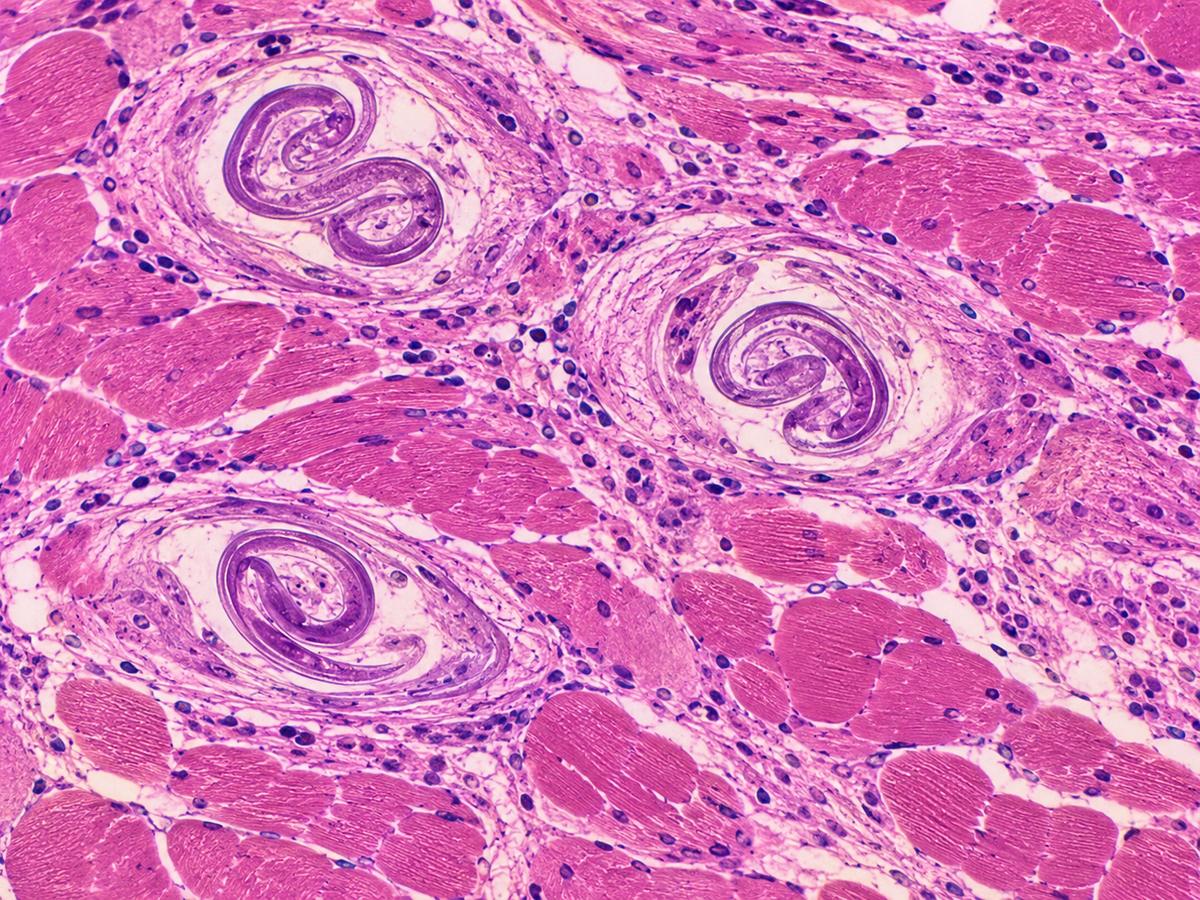
- The transformed cell is called a nurse cell, a name that describes its function exactly: it feeds and shelters the larva.
- Because the whole larva sits inside one cell, Trichinella is described as the largest intracellular parasite of humans.
Why it matters
The usual parasite story is theft. This one is closer to renovation, and that is what makes it scientifically interesting beyond the disease itself.
What's still uncertain
- The transformation has been studied mostly in rodents and in cell culture rather than in human tissue.
Read more
- CDC: About trichinellosisGovernment
Next: Switching off muscle
Dedifferentiation
What happens
The larva releases excretory-secretory proteins, and the muscle cell's identity comes apart.
What the research shows
- The contractile machinery, the actin and myosin filaments that make a muscle fibre contract, is dismantled.
- Muscle-specific genes are switched off and the cell re-enters a more primitive state, a process called dedifferentiation.
- The cell's nuclei enlarge and multiply, and the cytoplasm is reorganized.
- Mature muscle cells do not normally do any of this. They are among the most committed cells in the body, which is part of why muscle heals by scarring rather than regrowing.
Why it matters
Making a committed adult cell go backwards is something laboratories spend a great deal of effort trying to achieve on purpose. This worm does it routinely.
What's still uncertain
- Which of the hundreds of secreted proteins is responsible has not been settled.
Read more
- CDC: About trichinellosisGovernment
Next: Building a blood supply
Angiogenesis to order
What happens
A cell that has stopped being muscle still needs feeding, and so does the worm inside it.
What the research shows
- The nurse cell releases vascular endothelial growth factor, VEGF, the same signal the body uses to grow new vessels during healing.
- Nearby capillaries respond by growing a dense network around the infected cell.
- That network delivers a continuous supply of glucose, amino acids and oxygen.
- The same signal is used by tumours to grow their own blood supply, which is why this mechanism attracted attention well beyond parasitology.
Why it matters
The worm does not have to go looking for food. It arranges for the food to be delivered, by borrowing a signal the body already understands.
What's still uncertain
- Whether blocking angiogenesis would affect established infections has not been tested as a treatment.
Read more
- CDC: About trichinellosisGovernment
Next: The capsule
A collagen wall, then calcium
What happens
The last stage of construction is defensive.
What the research shows
- Over three to four weeks the nurse cell lays down a thick double-layered collagen capsule around itself.
- The capsule keeps large immune cells out, while remaining permeable enough for nutrients to pass in.
- Over months to years the body deposits calcium in the capsule, and these calcified cysts are sometimes seen by chance on X-rays taken for other reasons.
- Calcification is often described as killing the larva, but it is slow and incomplete: viable larvae have been recovered from human muscle years after infection.
- One species, T. pseudospiralis, never forms a capsule at all, and infections with it look different.
Why it matters
The capsule is why muscle biopsy can find the parasite long after blood tests and symptoms have settled.
What's still uncertain
- How long larvae remain viable inside calcified capsules in humans is not well established.
Read more
Next: What it costs you
Why the muscle phase hurts
What happens
All of this construction happens in your muscle, several thousand times over in a significant infection.
What the research shows
- Each invaded fibre stops working as muscle, which contributes to weakness in heavy infections.
- The immune system reacts strongly to the larvae and their secretions, producing myositis, inflammation of the muscle itself.
- That inflammation, not the worm's physical size, causes most of the pain and tenderness.
- Muscle enzymes such as creatine kinase rise in the blood, which is one of the laboratory clues to the diagnosis.
- As inflammation settles, pain resolves over weeks to months, though fatigue and aching can linger in heavy infections.
Why it matters
The pain is your immune system's response, which is also why corticosteroids are sometimes added in severe cases, alongside antiparasitic treatment rather than instead of it.
What's still uncertain
- How much permanent muscle loss occurs after heavy infection has not been well quantified.
Read more
- CDC: Trichinellosis clinical careGovernment
- OwieClear: The high-risk complicationsOwieClear