How insulin resistance develops
Last reviewed November 17, 2026. OwieClear editorial team. Waiting for clinician review. Not medical advice. Talk with your doctor about your own care.
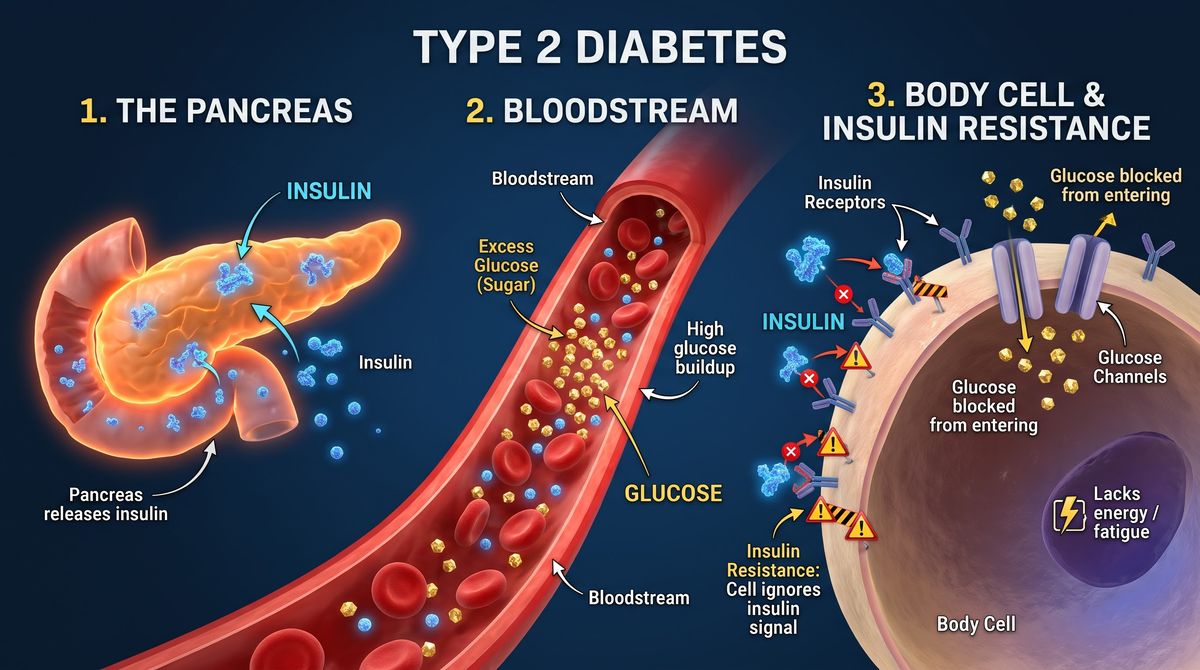
Insulin is the signal that tells cells to take glucose out of the blood. Insulin resistance means the signal is still being sent but the cells respond weakly.
The body's first answer is to shout louder, making more insulin. That works for years, and it is why blood sugar can stay normal long after the underlying problem has begun.
Related pages: Type 2 diabetes
The bottom line
- Insulin moves glucose into muscle and fat, and tells the liver to stop making its own glucose.
- In insulin resistance, all three tissues respond poorly, and the liver keeps releasing glucose even after a meal.
- Fat stored inside muscle and liver cells, rather than fat on the body in general, interferes with insulin signalling.
- High insulin levels precede high glucose levels, often by many years.
- Muscle contraction moves glucose into cells by a route that does not need insulin at all.
- Exactly which molecular step in the insulin signalling chain fails first.
- Why some people with a great deal of body fat remain insulin sensitive.
- The relative weight of inflammation, fat metabolites and mitochondrial function in causing resistance.
The story, step by step
What the evidence labels mean
What insulin actually does
What happens
A key, a lock and a door.
What the research shows
- After a meal, carbohydrate is broken down to glucose and absorbed into the bloodstream.
- Rising glucose triggers beta cells in the pancreas to release insulin.
- Insulin binds a receptor on the surface of muscle and fat cells. That sets off a chain of signals inside the cell.
- The end of that chain moves glucose transporters, mainly GLUT4, to the cell surface, where they let glucose in.
- Insulin also tells the liver to stop producing glucose and to store it as glycogen instead, and tells fat tissue to stop releasing fatty acids.
- Within about two hours of a normal meal, blood glucose returns to baseline and insulin falls back.
Why it matters
Insulin is not only a sugar hormone. It is the body's fed-state signal, and resistance to it disturbs fat and liver metabolism as much as glucose.
What's still uncertain
- How the same receptor produces different effects in different tissues.
- Why the liver can be resistant for glucose production while remaining sensitive for fat production.
Read more
- NIDDK: Insulin resistance and prediabetesGovernment
- MedlinePlus: Blood glucoseGovernment
Next: The fault
Where the signal breaks down
What happens
The chain inside the cell stops transmitting.
What the research shows
- In insulin resistance the receptor is usually present and insulin binds it, but the internal signalling chain transmits poorly.
- Fewer glucose transporters reach the cell surface, so less glucose enters muscle after a meal.
- Fat accumulating inside muscle and liver cells, rather than in fat tissue where it belongs, appears central. Lipid intermediates interfere directly with insulin signalling.
- Fat tissue under strain releases inflammatory signals and free fatty acids, both of which worsen resistance elsewhere.
- The liver's resistance is particularly important: it keeps releasing glucose overnight, which is why fasting glucose rises.
- Fat in the liver, now the most common chronic liver condition worldwide, travels closely with insulin resistance in both directions.
Why it matters
This explains why where fat sits matters more than how much there is, and why abdominal and liver fat predict diabetes better than weight alone.
What's still uncertain
- Which lipid species are the direct culprits.
- Whether inflammation is a cause of resistance or a consequence.
Read more
- NIDDK: Insulin resistance and prediabetesGovernment
- NIDDK: Type 2 diabetesGovernment
- American Diabetes Association: standards of care resourcesNonprofit
Next: The compensation
Years of high insulin
What happens
The pancreas shouts louder.
What the research shows
- Beta cells detect the rising glucose and increase insulin output, often several-fold.
- This succeeds. Blood glucose stays in the normal range while insulin levels are high, a state called compensatory hyperinsulinemia.
- During this period an ordinary glucose or A1C test looks entirely normal. Only insulin measurement, rarely done in practice, would reveal it.
- High insulin promotes fat storage and sodium retention, and is associated with high blood pressure, abnormal lipids and the skin change acanthosis nigricans.
- This is why many people have the full picture of metabolic syndrome long before any diabetes diagnosis.
- The compensation phase can last ten years or more.
Why it matters
The silent decade is the reason type 2 diabetes seems to appear suddenly. The diagnosis is late in the process, not early.
What's still uncertain
- How to identify the compensation phase cheaply in routine care.
- Whether intervening during it changes long-term outcomes.
Read more
- NIDDK: Insulin resistance and prediabetesGovernment
- CDC: Type 2 diabetesGovernment
Next: The failure
Why beta cells give out
What happens
Sustained overwork, plus damage.
What the research shows
- Beta-cell function declines progressively. By the time of diagnosis, a substantial fraction of capacity has typically been lost.
- Several processes are implicated: glucotoxicity from chronic high glucose, lipotoxicity from fatty acids, and deposition of islet amyloid protein in the pancreas.
- Some beta cells appear not to die but to dedifferentiate, losing their specialised function. This matters because dedifferentiation may be reversible in a way that cell death is not.
- The incretin system also falters. Gut hormones GLP-1 and GIP normally amplify insulin release after a meal, and that amplification is blunted.
- Alpha cells in the same islets continue releasing glucagon inappropriately, telling the liver to produce more glucose at exactly the wrong moment.
- This progressive decline is why treatment often needs to be stepped up over years, and why that is not a personal failure.
Why it matters
Diabetes gets harder to control with time because of biology, not because of willpower. It also explains why early intensive treatment and early weight loss give the best results.
What's still uncertain
- How much beta-cell function can be recovered after remission.
- Whether any current drug genuinely slows the underlying decline.
Read more
- NIDDK: Type 2 diabetesGovernment
- NIDDK: Insulin, medicines and other diabetes treatmentsGovernment
- American Diabetes Association: standards of care resourcesNonprofit
Next: The exception
Muscle takes a different route
What happens
Exercise bypasses insulin entirely.
What the research shows
- Contracting muscle moves glucose transporters to the cell surface through a pathway independent of insulin.
- This is why a walk after a meal lowers blood glucose even in people with marked insulin resistance.
- The effect on insulin sensitivity lasts roughly 24 to 48 hours after a session, which is the reason activity is recommended most days rather than in one weekly block.
- Muscle is the largest site of glucose disposal in the body, so the amount of muscle matters as well as how often it is used.
- Resistance training improves glucose handling through a different route from aerobic exercise, by building the tissue that does the disposing.
- Losing fat from inside the liver, which can happen within weeks of calorie reduction, improves fasting glucose quickly and before much weight is lost.
Why it matters
Two of the most effective interventions in type 2 diabetes work by routes that go around the broken signal rather than trying to repair it.
What's still uncertain
- The optimal combination and timing of aerobic and resistance work.
- How quickly liver fat reduction translates into lasting glucose improvement.
Read more
- CDC: Get active with diabetesGovernment
- NIH: Look AHEAD study of intensive lifestyle interventionGovernment
- NIDDK: Managing diabetesGovernment